Smart homes optimize for control. Home management systems optimize for outcomes. This article dives into the smart home vs home management system and gives detailed overview for both.
A smart thermostat will not call an HVAC technician when your compressor starts to fail. We’ve spent roughly $150 billion globally on smart home devices in 2025 a market projected to nearly double by 2030. American households now own an average of tens of billions of connected IoT devices collectively, with the typical smart-home household spending over $500 per year on devices, subscriptions, and services.
And yet, despite all that spending, the average homeowner is no better at actually maintaining their home than they were 15 years ago. The roofs still leak. HVAC still fails on the hottest day of the year. The water heaters still rust through silently because nobody thought to flush them.
These are not the same thing. They are not even adjacent things. Owning a connected thermostat is to managing the long-term health of your home what owning a treadmill is to being healthy there’s a relationship, but only if a much larger system surrounds it. And that larger system is exactly what the smart home category was never designed to deliver.
What a Smart Home Actually Is (and What It Was Designed to Do)
Strip away the marketing and a smart home is a collection of individually controllable devices, each connected to the internet, each managed by an app, each operating independently of every other thing happening in your home.
The category was born from a simple consumer desire: convenience through control. Turn off the lights from your phone. See who’s at the door from your office. Adjust the thermostat from bed. These are real, useful things. Smart‑home devices solve them well.
But “convenience through control” is a fundamentally different problem than “keep my home from quietly falling apart.” Smart‑home category solved the first and was never engineered to solve the second. Three structural reasons why:
Devices are atomic, not integrated
Industry analysis confirms that smart‑home ecosystem fragmentation is one of the leading reasons homeowners abandon devices: lighting from one brand doesn’t talk to thermostats from another, security systems live in their own walled garden, appliances each ship with their own app and their own login. The average smart‑home household ends up with a graveyard of apps, half of which they no longer remember the password to.
Even the industry‑wide push for Matter – the 2022 interoperability standard is fundamentally about making devices talk to each other, not about making them maintain your home.
They monitor present state, not long‑term health
A smart thermostat tells you the temperature right now. It does not tell you that your HVAC system is six months past its annual maintenance window. A water leak detector alerts you when there’s already water on the floor. It does not tell you that your washing machine hose has been bulging for three weeks. The category is engineered around real‑time signals, not lifecycle management.
The vendor is a device manufacturer, not a home advocate
Google, Amazon, Apple, Samsung, Honeywell these companies sell devices and ecosystems. Their incentive is to keep you buying more devices. None of them have a financial reason to call you when your roof needs an inspection, hold a contractor accountable for a bad job, or warn you that the dryer vent you’ve never cleaned is a leading cause of residential fires. Their economic relationship with you ends at checkout.
This is why every “smart home” even one packed with $5,000 of connected devices still leaves the homeowner managing the actual care of the home with sticky notes, mental reminders, and the occasional panic.
What a Home Management System Actually Does
A home management system isn’t a device. It’s not an app. It’s not an ecosystem of products. It’s a layer of intelligence and accountability that sits above the physical home and treats it the way a serious financial advisor treats a portfolio: as something requiring active stewardship, documented decisions, and proactive intervention to preserve and grow value over decades.
Concretely, a home management system tracks the things smart devices ignore:
- Service history. Every maintenance event, who performed it, what was done, what was charged, what was warrantied. Across years.
- Lifecycle awareness. When systems were installed, when they’re due for service, when they’re approaching end of life, when warranties expire.
- Vendor relationships. Who’s done good work, who hasn’t, what each provider charges, what they’re actually qualified to handle.
- Documentation. Every receipt, manual, warranty, photo, and report organized and retrievable in the moments that matter (insurance claims, resale, emergency repairs).
- Financial visibility. What the home actually costs to operate, where money is going, what’s an investment vs. what’s slow leakage.
- Proactive alerts. Reminders that arrive before the season changes, before the warranty expires, before the maintenance window closes.
Notice what’s not on this list: controlling lights, locking doors, viewing cameras, adjusting temperature. Those are smart‑home concerns. They’re real, but they’re a separate category.
The home management system is for the 95% of homeownership that happens between smart‑home interactions. It’s the layer that makes sure your home is still a healthy, valuable, well‑documented asset 10 years from now instead of a slowly‑decaying collection of deferred problems with great voice control.
Smart Home vs Home Management System : A Direct Comparison
The two categories solve different problems for different timeframes. Side by side:
| Smart Home | Home Management System | |
| Core function | Control devices in real time | Manage the long-term health of the home |
| Time horizon | This moment right now | Over years, across seasons, lifetime of the home |
| What it tracks | Device state (on/off, temperature, motion) | Service history, warranties, vendors, finances, documents |
| Who it serves | The user, in the moment | The asset, over its lifecycle |
| Primary output | Convenience | Equity protection + reduced cognitive load |
| What it prevents | Forgotten lights, missed deliveries | Catastrophic repairs, denied insurance claims, value loss at resale |
| Vendor incentive | Sell more devices | Keep your home maintained (you’re the customer) |
| Failure mode | Devices abandoned, apps forgotten, ecosystems fragmented | Doesn’t really have one it’s the system that catches other things’ failure modes |
| Replaces | Light switches, locks, thermostats | Sticky notes, junk drawers of warranties, group texts with your spouse, mental load |
This isn’t a sliding scale, the two are orthogonal. Consider a property: with neither, it’s problematic. With only smart devices, you get real‑time control of a slowly decaying asset. Only a management system, you have a maintained asset operated via light switches. With both, you gain convenience and stewardship, but it’s the management system that protects the value.
Why Smart-Home Marketing Doesn’t Mention Any of This
Worth saying plainly: the smart‑home industry has spent a decade telling consumers that “smart” equals “managed.” That a connected home is a cared‑for home. That if you can see your front door from your phone, you’ve achieved some kind of homeownership upgrade.
It’s not true. And it’s not true by design, because the device makers have no business model that rewards them for caring about the long‑term health of your home.
Three telltale signs the marketing is misdirected:
Smart home as security theater
A connected camera that records a break‑in doesn’t prevent the break‑in. A water‑leak sensor that alerts after your basement floods doesn’t undo the damage. These products are useful, but they market themselves as protection while delivering, mostly, better visibility into things that have already gone wrong.
Smart home as energy efficiency
Smart thermostats can modestly reduce energy use typically 10–15% on heating and cooling according to the U.S. Department of Energy but only when the underlying HVAC system is well‑maintained. A smart thermostat on a system with a clogged filter and a 2‑year‑overdue service is just a more expensive way to run an inefficient system. The actual driver of efficiency is maintenance whereas thermostat just measures the result.
Smart home as the future
It’s worth noticing what the smart‑home category has not delivered after 15 years and $150 billion of investment: any meaningful reduction in the average homeowner’s repair bills, claims rate, or value loss at resale. The smartest smart home in 2026 still suffers the same dryer‑vent fires, water heater failures, gutter‑induced foundation problems, and roof failures as a 1985 home with no automation at all.
The fundamental problems of homeownership were never device problems. They were management problems.
How They Work Together
This isn’t a “smart homes are bad” argument. They aren’t. Convenience is a real benefit, and many smart‑home devices are well‑designed and worth owning.
The argument is about which one actually protects your home, and what role each plays.
- Smart‑home devices are sensors and actuators. They give your home eyes, ears, hands, and a voice. That’s genuinely useful but a body without a brain is just twitching.
- A home management system is the brain. It interprets the sensors, remembers the history, schedules the actions, holds the vendors accountable, and stewards the asset over time.
The right architecture is both but only one of them is the layer that actually keeps your home healthy, valuable, and documented. The other is the layer that lets you turn the lights off from the airport. Useful, but not the same thing.
Homeowners who get this right buy fewer smart devices than the marketing suggests, but invest in the management layer the marketing never mentions. They end up with a home that runs better, costs less to maintain, holds its value, and creates dramatically less cognitive load. Not because they automated more, but because they managed more.
See how a seasonal maintenance checklist fits into a management system →
How HomeDaddy Approaches This
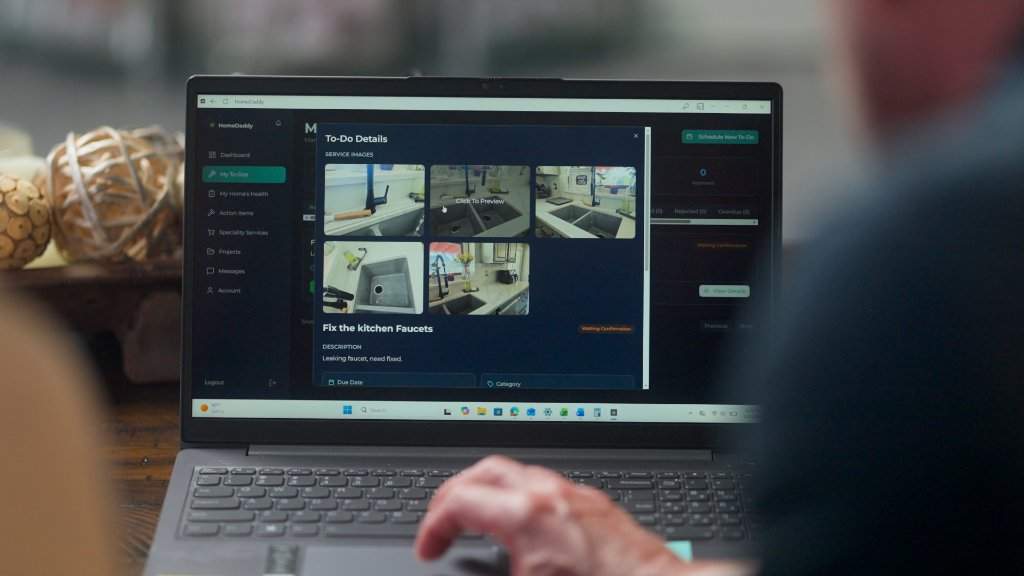
HomeDaddy is unapologetically a home management system, not a smart home platform. We don’t sell thermostats. We don’t have a doorbell camera. We don’t try to compete with Google Home or Amazon Alexa, because we’re not in that business.
What we do is sit above your home whatever devices you have or don’t and run the layer that smart‑home devices weren’t designed to deliver:
- The maintenance schedule, automated.
- The vendor network, vetted and structurally accountable.
- The document vault, organized and instantly retrievable.
- The seasonal alerts, before the season.
- The financial visibility, by category.
- The home’s complete history, retained across vendors, contractors, and years.
If you have smart‑home devices, great they slot into the HomeDaddy record as additional data sources. We can pull device data into your home’s history. But the value of HomeDaddy isn’t in the devices. It’s in the layer that turns ownership from a series of reactive events into a proactively managed asset.
That’s “the care your home never had.” Not in marketing language in operational reality.
Frequently Asked Questions
A smart home is a collection of internet-connected devices (lights, thermostats, locks, cameras) that
give you real-time control over your home. A home management system is a layer of intelligence that manages the long-term health of the home maintenance schedules, vendors, warranties, documents, and lifecycle tracking.
Not strictly but they solve different problems. Smart-home devices add convenience and visibility. A home management system protects the value of the asset. Most homeowners over-invest in devices and under-invest in management; the real impact on home value, repair costs, and resale comes from the management layer, not the devices.
Marginally, in narrow categories a smart thermostat may reduce heating/cooling costs by 10–15%, and water-leak sensors can catch leaks early. But the bulk of homeowner repair costs come from deferred maintenance on systems smart devices don’t track or manage (HVAC service intervals, water heater flushing, gutter cleaning, roof inspection, dryer vent cleaning).
Their business model is selling devices and ecosystems, not stewarding home health. A smart-home
company has no financial incentive to remind you to flush your water heater or schedule a roof inspection those don’t sell more devices. Home management is a fundamentally different category with different economics.
Maintenance scheduling, a vetted vendor network, document vault, warranty tracking, expense visibility, seasonal alerts, complete service history, and the proactive management layer that keeps your home
maintained over years. Devices stay where they are; HomeDaddy is the system above them that makes sure the actual care of the home happens.
The Bottom Line
For 15 years and $150 billion, the smart‑home industry has told homeowners that connectivity equals care. It doesn’t. Connectivity equals visibility into the present moment. Care is something different it’s lifecycle management, documentation, vendor accountability, and the patient, multi‑year work of keeping a home healthy.
Devices can’t do that. The category was never designed to. And the longer homeowners confuse one for the other, the more they spend on the wrong layer of the stack while the actual value of their largest asset quietly erodes underneath.
Your home doesn’t need to be smarter. It needs to be managed. That distinction is worth more than every connected device you’ll ever buy.